I hope you have enjoyed reading the last 4 issues of the “7 Basic Things You Need To Know During Start-up Year” as much I enjoyed writing them. Again, here's the complete list:
(1) Types of Business Organizations
(2) Business Product to sell and manufacture and service to perform
(3) How to keep business records
(4) Planning to have employees or sub-contracting
(5) Year-end Requirements
(6) Dealing with the taxman (Canada Revenue Agency)
(7) Preparing for the next fiscal period
 |
| Downtown Seattle, WA, USA |
This time I will be writing about “Year-end Requirements”. I would say, for some it’s the most exciting part of the business. Why is that? This is when the company finds out if it makes profit (or loss) during the fiscal period reported.
5 Things to Do at Year-end
a) Preparation of Year-end Financial Statements and Closing of Books
b) Management’s Reports
c) Reviewer or Auditor’s Report
d) Preparation of Annual Report
e) Annual General Meeting (AGM)
 |
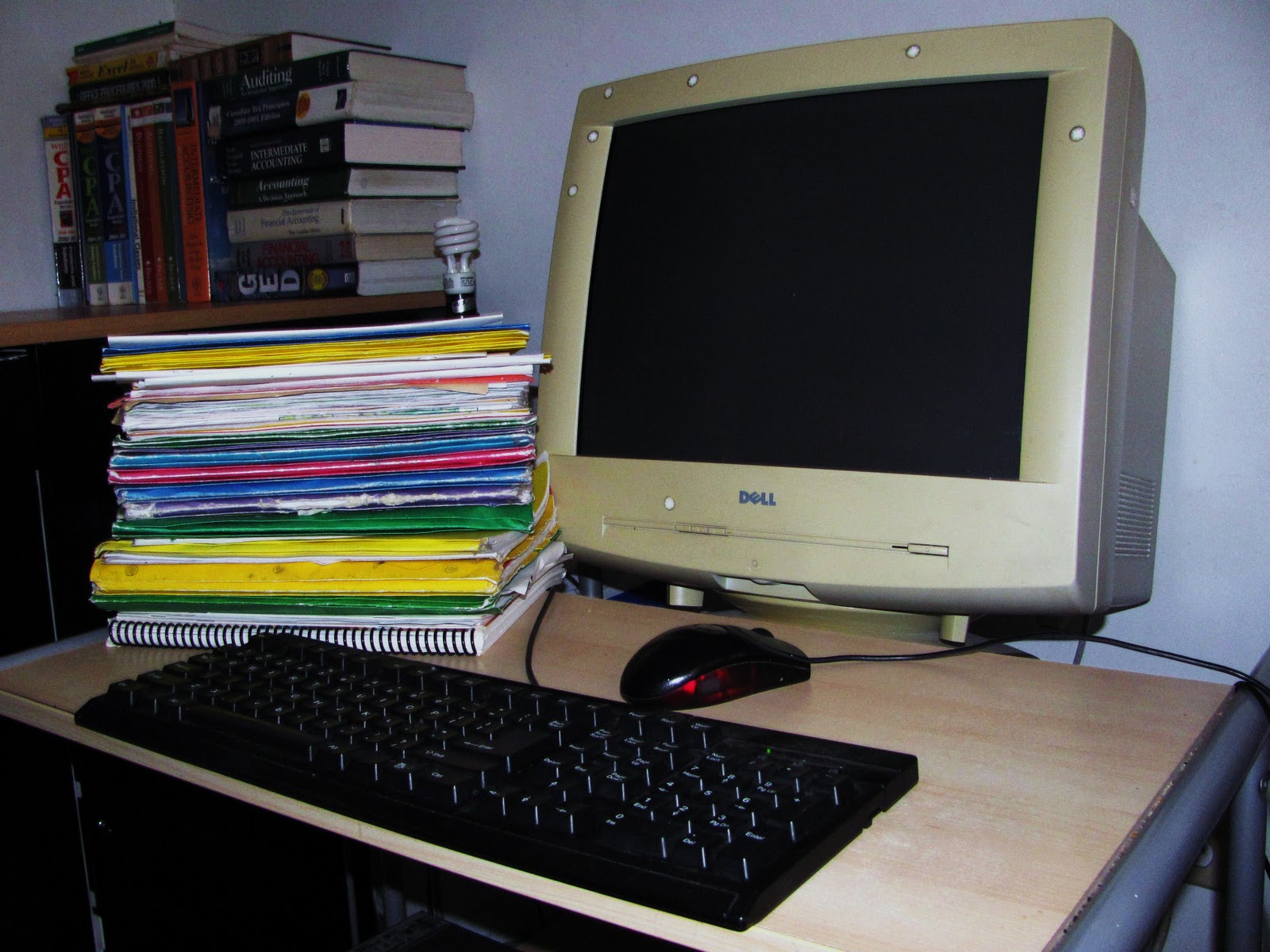
| One of our computer stations:) |
Preparation of Year-end Financial Statements and Closing of Books
In Part one (1) I wrote about the 3 types of Business Organizations: (1) Sole Proprietorship, (2) Partnership and (3) Corporation. All 3 are required to keep business records (see Part 3), so at the end of the year the company can have a better picture regarding its business activities throughout the entire year in form of financial statements. These statements are used as tools for decision making, for further improvement, either it’s for expansion or seeking additional investments or financing. Usually financial statements include, Income Statement, Statement of Retained Earnings, Balance Sheet, and Statement of Cash Flow or Statement of Changes in Financial Position (if required).
Preparation of year-end financial statements becomes easier if the company has done most of the regular bookkeeping/data entries throughout the fiscal period. So by the end of the year, all it needs is to do a few steps and that includes the preparation of the year-end financial statements. For some who have chosen not to use accounting software, and decided to prepare their financial statements from scratch (manual accounting system), there are a few steps before financial statements are prepared, called the Phases of Accounting Cycle. These phases can be group into two: (1) Prepared throughout the year and (2) Prepared during the end of year.
 |
| One of the food stores during an Abbotsford Airshow we attended |
Throughout the year includes collection of raw data, and related business information transactions and events happened. This information is analyzed and recorded for journalizing. These journal entries (JE) are then posted to each general ledger (GL) accounts.
At the end of the year, unadjusted trial balance (TB) for each GL account is listed. Then adjusting entries are performed for accurate, unbiased, and reliable presentation of amounts in the financial statements. Adjusting entries are usually performed for few accounts like accrued income and expenses; depreciation of fixed/tangible or intangible assets, bad debts expense, supplies used, and prepaid expenses. For example, accounts which are affected by more than one fiscal period such as: interest expense for long-term liability, rent expense for lease paid for more than a year, tax expense incurred for the current year but not yet paid. Also, insurance expense paid for more than one year, wages accounted and still owing at the end of fiscal period. Lastly, overstatement or/and understatement of amounts are also done during adjusting entries before preparation of year-end financial statements are performed.
Once adjusting entries are recorded on the Journal and posted on the General Ledger, Financial Statements are prepared from the adjusted accounts. After the financial statements have been prepared, then closing entries can be done to close the books.
 |
| A snack shop on our way to a sport related event in Kamloops, BC Canada. |
Closing of books is performed by transferring the income and expenses balances to Income Summary, which closed to Owner or Partners’ Investment (for sole proprietorship and partnership) or Retained Earnings (for corporation). After posting, only the Balance Sheet accounts will show up. There would be no income and expenses balances from Income Statement that will show. The income and expense accounts will have zero balances, and being ready for the next fiscal period. Only current Balance Sheet accounts will be carried forward for the next fiscal period.
Lastly, Post-Closing Trial Balance is performed. This is to check the debits and credits of the adjusting entries and closing entries, whether they are done properly, and reflected in the Balance Sheet amounts that will be carried forward for next fiscal period.
 |
| A flower design shop store, during a sport community event. |
Management Report
Though management report is not usually required for a one-person managed company, but it is advisable for a company that has a manager, who is usually responsible for the day-to-day managing of the business operation. Besides the financial statements presented, it is another useful tool for related parties for their decision-making as to the best interest of the company.
This report is the representation of the manager (s) of the company, usually signed by the highest position related to the management of the business. For bigger companies, management report is usually signed by a Chief Operating Officer, Chairman or President, Chief Operating Officer, Vice President, Chief Financial Officer, or just your only staff, your business manager of your business.
Management Report is usually based from the financial condition of the company. If they are bigger companies, management staff usually applied the Management Discussion and Analysis (MDA) method. MDA is a more detailed discussion of accounting principles used in the preparation of the Balance Sheet and Income Statement accounts, and if parent company has subsidiaries, these accounting principles are being applied for consolidated financial statements of the subsidiaries as well.
It will likely include the liquidity of its resources, recent accounting standards applied in the preparation of the financial statements. Also, it might include information related to investments and the market risk of exposure involvement associated, and information related to Security Exchange Commission, like SEC new rules.
Basically, management report will include these items on their report:
- Management taking responsibility of the financial related information presented in the annual report.
- Management is responsible for the objectivity, reliability, integrity and consistency of information in the financial statements.
- Management is stating that the financial statement have been prepared in accordance of Generally Accepted Accounting Principles (GAAP) in Canada (or country being reported to, usually the parent company’s business is located).
- Management has exercised reasonable judgment and best estimate appropriate for the situation have been applied.
- Management responsibility on reliability of company accounting systems, related internal control to support procedures, and provide reasonable assurance of the financial statements.
- It will also include how the management safeguard the company assets, and staff accountability to the company as a whole.
- If applicable, it might include information regarding the role of the Audit Committee of the Board of Directors of the company, their responsibilities in the financial reporting, internal control systems and other related matters with the company’s internal auditor and external auditor.
- Basically, it is the management statement and representation of the company.
Compilation (Notice to Reader), Review or Auditor’s Report (If required)
Your company might not need a professional accountant to audit, review or compile your financial statements. However, for some companies which are seeking loans and possible investments, most prospective creditors and investors preferred to have an audited, reviewed, or compiled financial statements.
Out of the 3 reports (Compilation or Notice to Reader, Review and Auditor’s report) the auditor’s report has the highest reasonable assurance, then review, and then Notice to Reader. These types of reports, especially auditor’s report, just give extra credibility to the company’s financial statements on top of good accounting systems used in the preparation of these financial statements.
Companies on stock markets are required to have audited financial statements (it can be consolidated with parent’s subsidiaries’ financial statements) by their investors, and governing agencies like the Securities Exchange Commission (SEC).
An auditor can give a company’s financial statements a reasonable assurance that the financial statements being presented are appropriately recorded based on specified criteria and truly reflect the transactions and events happened during the fiscal period.
 |
| A fancy place for an AGM? :) |
Preparation of Annual Report
The annual report is the most anticipated report by all parties concerned. Why is that? It is the report that contains information (not just the set of financial statements) occurred during the fiscal year. It is sort of a special newsletter by the management to their shareholders or/and other concerned parties (creditors or prospective investors) related to the annual operation activities of the company. Annual report will likely include:
- Opening letter addressed to Shareholders, or Members, or related parties
- Highlights of the financial and operating activities during the year.
- Management Discussion Analysis (MDA) of financial and operating activities of the company
- Management Report
- Auditor, Review or Compilation/Notice to Report (if required)
- List of Financial Statements (Income Statements, Balance Sheet, and Statement of Changes in Financial Position (or Statement of Cash Flows)
- Notes to Financial Statements will likely include items such as: type and description of the business, reorganization (not applicable on new start-up business), IPO information (if applicable), significant accounting estimates, new acquisitions, receivables and payables important information, financing, net capital requirement, stock options (if any), employees’ benefit plans (if any) , income taxes information, off-Balance Sheet items and credit risk, fair value of investments like financial instruments, and probably will include related party transactions (if any).
- It will likely include owners/shareholders/investors, board of directors, officers information as well
Please note that above listed items for compiling an Annual Report are not applicable to all companies, especially in a sole proprietorship and partnership types of business organization. Just pick the items that applied to your company accordingly.
Annual General Meeting (AGM)
AGM can have mixed feelings to all parties involved. But whatever result you are expecting, hopefully it is the best for yourself and most all for the entire company. Tension in an AGM is just normal, especially if it involves voting and re-electing of Board of Directors by shareholders, and appointing of officers by the Board of Directors. It’s not all that nerve racking though, since part of the AGM is the presentation of the company’s annual report. As mentioned previously, this report gives all related parties information on how the company’s performed during the fiscal period reported. Also during the AGM, some companies will pick this time of the year to do their giving of awards to those who went beyond their call of duties.
I always think AGM is a good way of starting fresh. People involved have another chance of proving themselves (if they didn’t fully accomplish everything in the last fiscal period). It is another chance to do their best for the company, and working with the best people, who have the same common goal, making healthy profits and at the same time serving the community.
 |
| One of New Years closed to Vancouver City Centre. |
______________________________________________________________________
Note: The continuation of this topic, “So You Want To Start Your Own Business?” will be continued on next post, “Part 6 of 7: (5) Dealing with the Taxman (Canada Revenue Agency (CRA) or other tax governing agencies like the IRS)”. Until then.
Please feel free to leave a comment or you may contact me at:
Earla Riopel, BSCom(USA), DipAcc(UBC)